
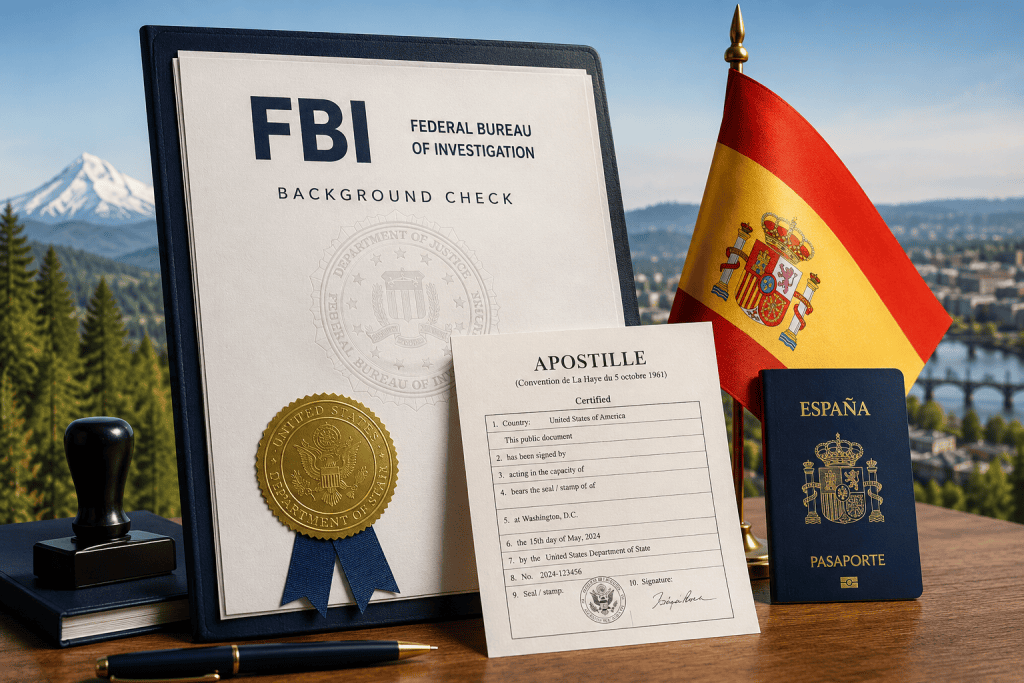
If you live in Oregon and you are preparing a Spain visa application, chances are you have already run into one confusing requirement: the FBI apostille for Spain visa approval. This single document trips up more applicants than almost anything else in the process, not because it is difficult, but because most people have never heard of an apostille before they needed one. Understanding exactly what the FBI apostille for Spain visa applications requires, and how to get it done properly from Oregon, can save you weeks of frustration and prevent a rejected application.
Need this done in the Portland area? PDX Fingerprinting offers FBI apostille service at our Beaverton, Hillsboro and Lake Oswego offices, plus mobile service across the Portland metro. Book an appointment online.
At PDX Fingerprinting, we work with Oregon residents every week who are starting the FBI apostille for Spain visa process for the first time. Whether you are relocating for work, joining family, enrolling as a student, or retiring abroad, Spain’s immigration authorities want proof that you do not have a criminal history in the United States. That proof comes from the FBI, and it must be authenticated in a very specific way before Spain will accept it. This guide walks through the entire process from start to finish, so you know exactly what to expect.
Why Spain Requires an FBI Apostille
Spain, like many countries that participate in the Hague Apostille Convention, requires foreign background check documents to carry an apostille certificate before they can be used in an official immigration proceeding. Without this certification, Spain’s consulates and immigration offices have no reliable way to confirm that a document is genuine. This is exactly why the FBI apostille for Spain visa requirement exists in the first place.
An apostille is essentially a certificate attached to your document that confirms it was issued by a legitimate authority in the United States. For federal documents such as an FBI Identity History Summary, this certification comes from the U.S. Department of State, not from Oregon’s Secretary of State office. This distinction matters enormously, and it is one of the most common mistakes Oregon applicants make when they begin the FBI apostille for Spain visa process on their own.
Many people assume that because they live in Oregon, they should submit their FBI report to the Oregon Secretary of State for authentication. Unfortunately, state level apostilles are only valid for documents issued by state agencies, such as a state background check or a notarized document signed within Oregon. The FBI is a federal agency, so any FBI apostille for Spain visa purposes must go through the Department of State’s Office of Authentications in Washington, DC. Sending your document to the wrong office is one of the most frequent causes of delay.
Which Spain Visa Categories Need This Document
Not every Spain visa requires a background check, but most long term visas do. If you fall into one of the categories below, you should plan on obtaining an FBI apostille for Spain visa submission as part of your paperwork.
Work visas are the most common category. If you have accepted a job offer in Spain and plan to relocate for employment, Spain’s labor and immigration authorities will almost always request a certified criminal background check from your country of residence. Since you have lived in Oregon, that means an FBI Identity History Summary with an apostille attached.
Residency visas, sometimes called non lucrative visas, are popular among retirees and individuals with passive income who want to live in Spain without working locally. These applications are reviewed carefully, and an FBI apostille for Spain visa filings under this category is typically mandatory, along with financial documentation.
Student visas for programs longer than 180 days often require the same background check. Universities and consulates want assurance that incoming students do not carry a criminal record, and the apostilled FBI report satisfies that requirement.
Family reunification and long term residency applications may also request this document, depending on the specific consulate handling your case. Requirements can vary slightly between Spain’s consulates in different regions of the United States, so it is worth confirming with the consulate assigned to your jurisdiction before you submit anything.

The Complete Document Checklist
Beyond the FBI apostille for Spain visa requirement itself, Spain immigration authorities may ask for several other federally issued documents, each of which also needs its own apostille from the Department of State rather than from Oregon. Here is what most applicants need to gather.
The FBI Identity History Summary is required for nearly all long term visas, residency applications, and eventual citizenship filings. This is the core document behind every FBI apostille for Spain visa case, and it is issued exclusively by the FBI’s Criminal Justice Information Services Division.
A Certificate of Naturalization, issued by USCIS, may be needed if you are applying based on citizenship by descent or dual nationality.
A Consular Report of Birth Abroad, issued by the Department of State, is sometimes requested for citizenship verification or school enrollment purposes.
An SSA Benefit Verification Letter may be required if you are applying under a retirement or pension based visa category, since Spain wants proof of stable income.
IRS Form 6166 can be requested if your situation involves tax treaty benefits or foreign tax compliance matters.
All of these documents share one thing in common with the FBI apostille for Spain visa requirement: they must be apostilled by the federal government, never by a state agency, because they were issued by federal agencies.
Step One: Get Fingerprinted the Right Way in Oregon
Before you can even think about the apostille itself, you need an official FBI Identity History Summary, and that starts with fingerprinting. This is where our team at PDX Fingerprinting comes in for Oregon residents pursuing the FBI apostille for Spain visa process.
You have two main options for submitting fingerprints to the FBI. The first is an electronic submission through an authorized channeler or approved fingerprinting location, which is generally faster. The second is a traditional ink and card submission mailed directly to the FBI, which takes considerably longer to process. For anyone working toward a time sensitive FBI apostille for Spain visa deadline, electronic submission is almost always the smarter choice.
At our Oregon location, we use certified digital fingerprint scanning equipment that captures clean, FBI compliant prints on the first attempt in the vast majority of cases. Rejected or smudged fingerprint cards are one of the biggest causes of delay for applicants pursuing an FBI apostille for Spain visa, since a rejected submission means starting the entire fingerprinting step over again. Working with an experienced local provider dramatically reduces this risk.
When you visit us, bring a valid government issued photo identification. Our technicians will capture your fingerprints electronically and prepare them for submission to the FBI’s Criminal Justice Information Services Division along with the required application.
Step Two: Pay the FBI Processing Fee
Once your fingerprints have been captured, the next step in the FBI apostille for Spain visa process is paying the FBI’s processing fee for the Identity History Summary. As of this writing, the standard fee charged directly by the FBI is eighteen dollars, payable by credit card, money order, or certified check, depending on the submission method you choose.
If you use an approved third party channeler for electronic submission, there may be an additional service fee on top of the FBI’s base charge. This is normal and covers the electronic transmission and processing service the channeler provides. It is worth noting that only the official report issued directly by the FBI can ultimately receive an apostille. Some third party summaries or alternative background check products are not accepted by the Department of State, so make sure whatever service you use is explicitly generating the official FBI Identity History Summary.
Step Three: Receive Your Official FBI Report
After your fingerprints and fee have been submitted, you wait for the FBI to process your request and return the Identity History Summary. Electronic submissions are typically processed within three to five business days, while mailed submissions can take anywhere from twelve to sixteen weeks. This difference alone is why so many Oregon applicants choose electronic fingerprinting when time is a factor in their FBI apostille for Spain visa timeline.
Once your report arrives, review it carefully. Confirm your name, date of birth, and other identifying information match what you provided, and check that the document has the FBI’s official letterhead and seal. Any errors or inconsistencies should be addressed with the FBI before you move forward, since the Department of State will not apostille a document that appears incomplete or improperly issued.
Step Four: Submit for Apostille Certification
With your official FBI report in hand, you are ready for the final and most important stage of the FBI apostille for Spain visa process, which is the apostille certification itself through the U.S. Department of State.
This part of the process typically unfolds in four stages, whether you handle it yourself or work with a document processing service.
First, your original FBI report is submitted, either by mail or through secure delivery, along with an order form specifying the destination country and the number of apostilles required. Since your document is headed to Spain, this should be clearly indicated on the paperwork.
Second, the submission undergoes a professional review to confirm it meets the Department of State’s strict formatting and authentication standards. This step verifies agency seals, signatures, and overall document integrity. Any issues identified here need to be resolved before the document can move forward, which is another reason working with an experienced processor helps avoid delays in your FBI apostille for Spain visa timeline.
Third, the document is delivered to the Department of State’s Office of Authentications in Washington, DC. Standard processing at this stage generally takes about ten to twelve business days from the date of submission, though expedited options may be available for urgent visa deadlines.
Fourth, once the apostille certificate has been issued and attached, the completed document is returned to the applicant through a secure shipping method, typically with tracking and insurance included given the sensitive nature of a federal background check.
Translation Requirements for Spain
Many Spain consulates and immigration offices require that apostilled documents be accompanied by a certified translation into Spanish. This requirement can vary depending on which consulate is handling your application and which visa category you are applying under, so it is worth confirming directly with your specific consulate before your appointment.
If a translation is required, it generally needs to be a certified or sworn translation, not simply a translation you complete yourself, even if you are fluent in Spanish. Consulates typically want a translator’s certification statement attached, confirming the translation is accurate and complete. Coordinating this alongside your FBI apostille for Spain visa paperwork ahead of time prevents a last minute scramble before your visa appointment.

Timeline Planning for Oregon Applicants
Because so many separate steps are involved, timeline planning is one of the most important parts of managing an FBI apostille for Spain visa application successfully. Most Spain consulates require the background check to be recent, typically issued within three to six months of your visa appointment date. If too much time passes between when your document is issued and when you actually submit your visa application, you may be asked to start the entire process over again.
Given the FBI processing time, the apostille processing time, and any translation work, we generally recommend Oregon applicants begin their FBI apostille for Spain visa process at least six to eight weeks before their planned visa appointment. This buffer allows enough room for electronic fingerprint submission, FBI processing, apostille certification at the federal level, and certified translation, while still leaving a small cushion in case any step takes longer than expected.
If your timeline is tighter than that, do not panic, but do act quickly. Expedited processing options exist at several stages of the FBI apostille for Spain visa process, from faster fingerprint appointments to rush apostille service. The sooner you identify a compressed timeline, the more options you will have to speed things up.
Common Mistakes That Delay an FBI Apostille for Spain Visa
Over the years, we have seen the same handful of mistakes trip up otherwise well prepared applicants.
Submitting fingerprints to the wrong channel is a frequent issue. Not every fingerprinting service is authorized to transmit prints electronically to the FBI for an Identity History Summary request, and using an unauthorized service can result in delays or a rejected submission.
Sending an FBI report to a state Secretary of State for apostille is another common error. As mentioned earlier, only the Department of State in Washington, DC can apostille a federally issued document. A state apostille on an FBI report will not be accepted by Spain’s immigration authorities, and applicants who make this mistake often lose several weeks correcting it.
Letting the document expire before submitting the visa application is another pitfall. Because Spain typically wants a background check issued within three to six months of your appointment, starting too early can be just as problematic as starting too late.
Skipping the translation requirement, or assuming it does not apply to your specific consulate, can also cause an application to be rejected outright at the appointment stage. Always confirm translation requirements directly with your consulate well before you need to submit your paperwork.
Finally, using a background check product that is not the official FBI Identity History Summary is a mistake we see more often than you might expect. Some private background check companies market services that sound similar, but only the official document issued directly by the FBI’s Criminal Justice Information Services Division qualifies for apostille certification.
How PDX Fingerprinting Supports Your Application
For Oregon residents pursuing an FBI apostille for Spain visa application, the fingerprinting stage is the foundation of the entire process. A clean, properly captured set of fingerprints on the first attempt saves you from the frustration of resubmitting and waiting through the process a second time.
Our team specializes in electronic fingerprint capture for FBI Identity History Summary requests, and we understand the specific requirements involved when the resulting document needs to move forward toward apostille certification for international use. We can walk you through exactly what to expect at each stage, from fingerprinting through FBI processing, so that when it comes time to pursue your FBI apostille for Spain visa certification, your document is ready to move smoothly through the federal review and authentication process.
We also understand that every Spain visa case is a little different. A student visa applicant has different timing pressures than someone applying for a long term residency visa, and we tailor our guidance accordingly. If you are just starting to research the FBI apostille for Spain visa process, or if you already have an appointment scheduled and need fingerprinting completed quickly, our Oregon office is set up to help you move forward with confidence.
Final Thoughts
Navigating the FBI apostille for Spain visa process does not need to be overwhelming once you understand the sequence of steps involved. Start with properly captured fingerprints, submit your request for an official FBI Identity History Summary, wait for your report, and then route that report through the Department of State for apostille certification rather than any state agency. Confirm your consulate’s translation requirements early, and build in enough lead time before your visa appointment so that unexpected delays do not derail your plans.
Oregon residents preparing for a move, a job, a degree program, or retirement in Spain have successfully completed this process many times before, and with the right preparation, you can too. If you are ready to begin the fingerprinting stage of your FBI apostille for Spain visa application, our team at PDX Fingerprinting is here to help make that first step as smooth as possible.