Your agency, employer or licensing board just asked for fingerprints, and now you are seeing two terms: ink cards and Live Scan. Picking the wrong one can mean a rejected application and weeks of delay. Here is how to tell which one you need.
Need this done in the Portland area? PDX Fingerprinting offers Live Scan and ink fingerprinting at our Beaverton, Hillsboro and Lake Oswego offices, plus mobile service across the Portland metro. Book an appointment online.
What Is Ink Fingerprinting?
Ink fingerprinting means your prints are rolled onto a paper card, most often the FBI’s FD-258 card. You then mail the card to the agency with your application. Ink cards are the standard for out-of-state applications, many international visas and paper-based FBI requests.
What Is Live Scan Fingerprinting?
Live Scan captures your fingerprints on a digital scanner and sends them electronically to the agency or the FBI. There is no ink and no mailing, so results usually come back much faster. The catch: a state’s Live Scan system generally only works for that state’s agencies, from sites inside that state.
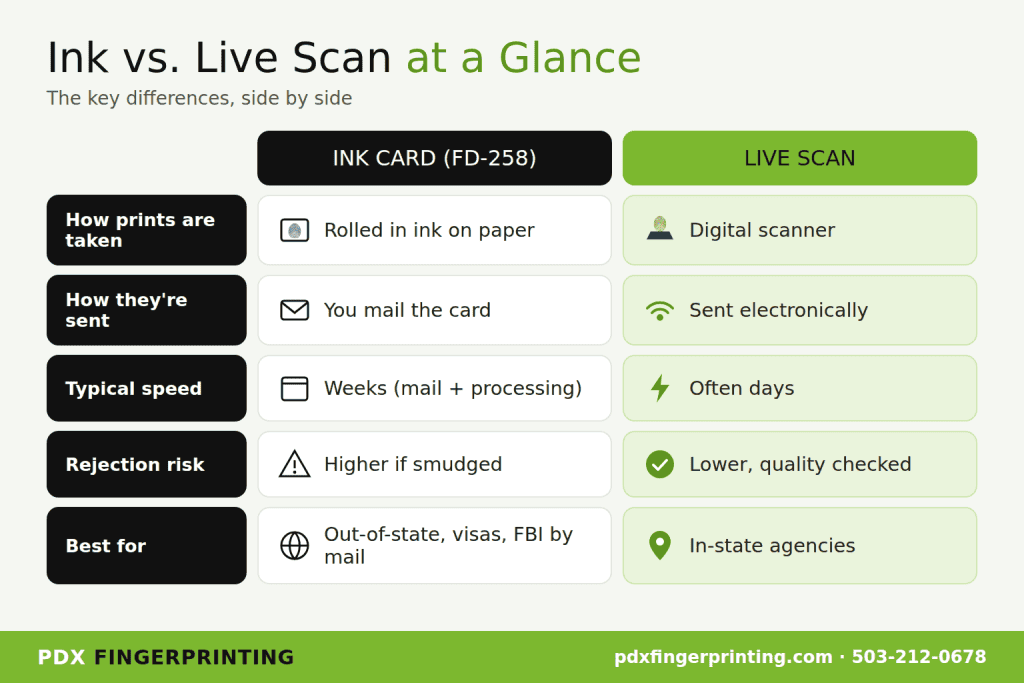
Ink vs. Live Scan at a Glance
| Ink Card (FD-258) | Live Scan (Electronic) | |
|---|---|---|
| How prints are taken | Rolled in ink on a paper card | Captured on a digital scanner |
| How they are sent | You mail the card | Sent electronically |
| Typical speed | Weeks (mail + processing) | Often days |
| Rejection risk | Higher if prints are smudged | Lower, the scanner checks quality |
| Best for | Out-of-state, visas, agencies that ask for cards | In-state agencies set up for electronic prints |
When You Need Ink Cards
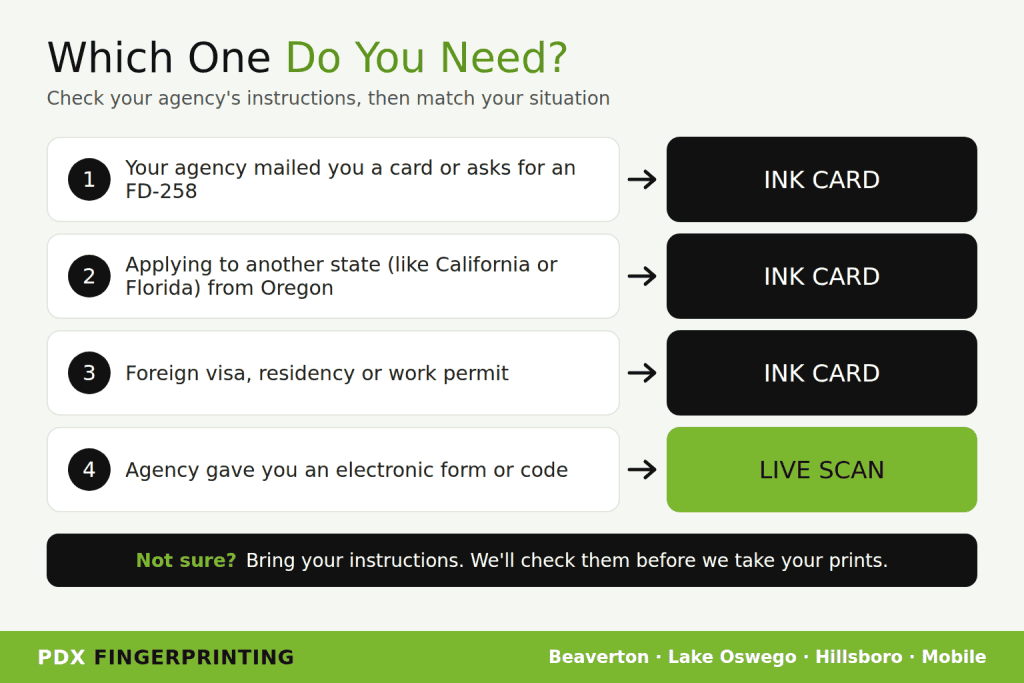
- Your agency mailed you a fingerprint card or asks for an FD-258
- You are applying to another state, such as California or Florida, while living in Oregon
- You need prints for a foreign visa, residency or work permit
- You are mailing an FBI Identity History Summary request yourself
When You Need Live Scan
- Your agency gave you an electronic fingerprinting form or code
- Your employer or licensing board says “no cards accepted”
- You want an FBI background check fast through an approved channeler
How to Know for Sure
Check your agency’s instructions first. They will name the card, form or vendor they accept. If the instructions are unclear, bring them to us. Our technicians see these requests every day and can help you read them before we take your prints.
Where to Get Fingerprinted in the Portland Area
PDX Fingerprinting offers ink cards and electronic fingerprinting at three offices: Beaverton, Lake Oswego and Hillsboro (open Saturdays), plus mobile fingerprinting anywhere in the Portland metro. Applying to another state? See our out-of-state fingerprinting page. Need an FBI check? Start with our FBI background check service.
Frequently Asked Questions
Is Live Scan better than ink?
Neither is better in general. Live Scan is faster and has fewer rejections, but it only works when your agency accepts electronic submissions from where you are. If your agency asks for cards, ink is the right choice.
Can I get California Live Scan in Oregon?
No. California Live Scan only transmits from approved sites inside California. Oregon residents normally submit FD-258 ink cards to the California DOJ instead.
Which one do I need for an FBI background check?
The FBI accepts both. You can mail an FD-258 ink card with your request, or submit electronically through an FBI-approved channeler, which PDX Fingerprinting arranges for you, for faster results.
How much does fingerprinting cost in Portland?
At PDX Fingerprinting, fingerprinting starts at $35. Agency processing fees are separate and paid to the agency.
Why do ink cards get rejected?
Smudged or faint prints, rolled prints that are not complete nail to nail, and missing or incorrect information on the card. A trained technician reviews every card before you leave to avoid this.