USCIS rejects or delays applications every day because of translation problems. The good news: the rule is short and clear. This guide explains exactly what USCIS requires for a certified translation, shows a sample certification, and covers the mistakes that cause Requests for Evidence.
Short answer: Any document in a foreign language that you submit to USCIS must come with a full English translation and a signed statement from the translator that the translation is complete and accurate and that they are competent to translate. You don’t need a notary or a government-licensed translator. PDX Fingerprinting provides certified translations formatted for USCIS.
What USCIS actually requires
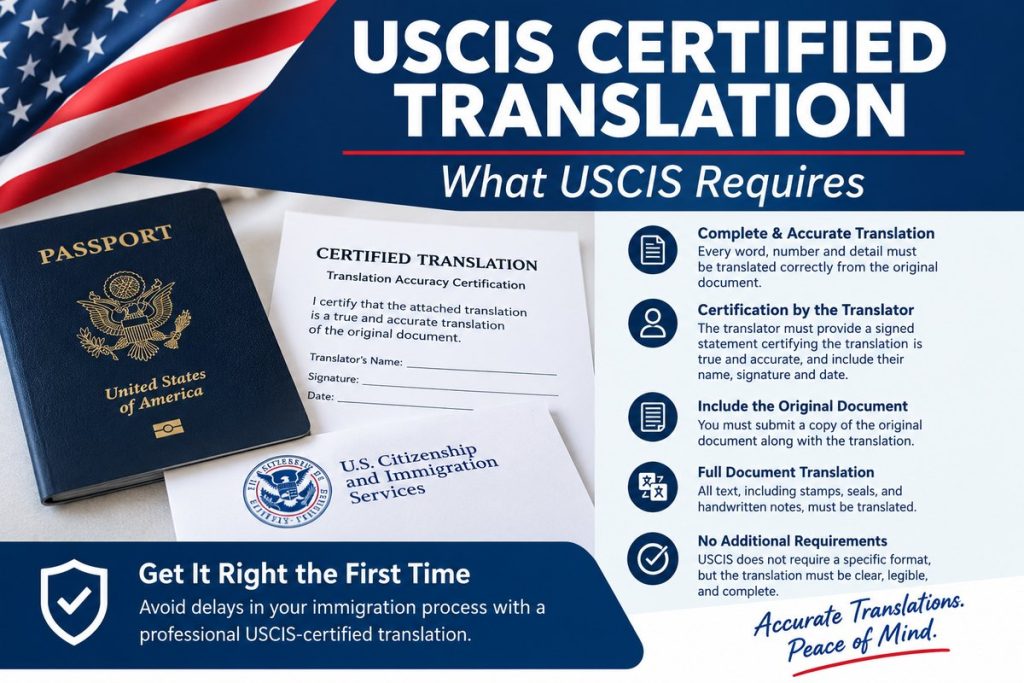
The rule is in federal regulations at 8 CFR 103.2(b)(3). In short, a foreign-language document must be accompanied by:
- A full English translation (not a summary or excerpt)
- The translator’s certification that the translation is complete and accurate
- The translator’s certification that they are competent to translate from that language into English
Sample translator certification
“I, [Full Name], certify that I am fluent in English and [Language], and that the attached English translation of the [document type, e.g. birth certificate of Maria Lopez] is complete and accurate to the best of my knowledge and ability.
Signature: ________ Date: ________
Name, address and phone number of translator”
Attach the certification to the translation, and submit both with a copy of the original document.
Mistakes that cause RFEs
- Translating only part of the document (stamps, seals and handwritten notes must be translated too)
- Missing translator signature, date or contact details
- Using a machine translation with no certification
- The applicant translating their own documents (avoid this, even if you are fluent)
- Name spellings that don’t match your other documents
Do you need notarization or an apostille?
Not for USCIS. Notarization isn’t required for USCIS translations. Apostilles are for documents used abroad; see do you translate before or after apostille if you’re sending documents to another country.
Certified translation in Portland
We translate birth and marriage certificates, diplomas, police records and more, with a USCIS-style certification. Translation is $65 per document (see pricing). Spanish? See our certified Spanish translation. Drop off at our Beaverton, Hillsboro or Lake Oswego office, or call 503-212-0678.
Common documents that need translation for USCIS
- Birth and marriage certificates
- Divorce decrees and death certificates
- Police certificates and court records
- Diplomas, transcripts and employment letters
- Bank statements and tax records
Tips to avoid an RFE
- Translate every page, including stamps, seals and handwritten notes.
- Keep the translator’s certification with each translation.
- Submit a copy of the original document along with the translation.
- Make sure names and dates match your other documents exactly.
Frequently asked questions
Does the translator need to be certified by an organization?
No. USCIS requires the translator’s own certification of competence and accuracy, not a specific credential.
Can a friend translate my documents?
Technically yes, if they are competent and sign the certification. Using a professional reduces the risk of errors and RFEs.
Do I send the original document?
Follow your form instructions. USCIS generally asks for copies unless it specifically requests originals.
Related reading: Notarized translations · Hillsboro translation services